Skip to content

Research literacy, not hype

The Peptide Standard

Peptide & Research Education

Understand the mechanism. Weigh the evidence. Know what a lab document can and cannot tell you. Then bring your questions to a community that reads the literature carefully.

Founded by Beardedmuscle

Research updates by email

New breakdowns, delivered when they're ready.

The latest in the world of peptides and research. Research updates and new findings. The learning never stops!

Checking signup availability…

01

Mechanism first

What a compound binds, signals and changes — explained in plain language before anyone talks outcomes.

02

Evidence, graded

A rodent study, a case report and a randomized trial are not the same claim. We say which one we are looking at.

03

Risk stated plainly

Unknowns, side-effect profiles and evidence gaps get the same airtime as the interesting findings.

04

Education only

No protocols or doses, and no products are sold here. Vendor listings remain on The Anabolic Standard. Personal health decisions belong with a qualified clinician.

The research library

Brief research breakdowns, read carefully.

Each brief names the compound, the experiment and the evidence layer, then says plainly where the findings stop. Search by mechanism, keyword or topic.

Read the Breakdowns

Research literacy

Three ideas worth having before any claim.

Short, original introductions to how we think about mechanisms, evidence and lab documents.
Primer I

Mechanism is a hypothesis

Knowing that a molecule binds a particular receptor, or shifts a signalling pathway, tells you how something could work. It does not tell you whether it produces a meaningful benefit in a living human, at what exposure, or at what cost.[1]

Medicines act by interacting with molecular targets such as proteins and receptors, and a medicine can also affect more than its intended target.[1] Biology is also full of redundancy and feedback. A clean mechanism diagram is where good questions start — and where marketing often stops.
Primer II

The evidence ladder

Findings in cells or animals often fail to carry over to people. The FDA notes that preclinical research cannot substitute for studies in humans, and that clinical research proceeds in phases, each with a different role in assessing safety and efficacy.[2]

  1. Rung 1

    Mechanism

    A compound binds a receptor or alters a pathway. Plausible — not proof.

  2. Rung 2

    Cell and animal studies

    Controlled, useful, but different biology, doses and timescales from people.

  3. Rung 3

    Human observational data

    Real people, but confounded. Association is not causation.

  4. Rung 4

    Clinical trials

    Phased testing of safety and efficacy in humans.

Primer III

Reading a certificate of analysis

A certificate of analysis (COA) is a quality document about one tested sample. The WHO model certificate describes the tests performed on a particular sample: the batch, the test methods, the acceptance criteria, the numeric results, and the person who authorized it with a date.[3]

What it shows

  • Sample and batch identity
  • Test methods used
  • Acceptance criteria
  • Numeric results obtained
  • Authorizing person and date

What it cannot show

  • That a compound is clinically safe
  • That it is effective in humans
  • The quality of a batch that was not tested

The limits follow from that scope: a COA reports laboratory measurements on one sample, so it is not evidence of clinical safety or efficacy, and it says nothing direct about a batch that was not tested. That is our inference from what the document covers, not a statement taken from the WHO text.

The Peptide Standard on Skool

Bring your questions.

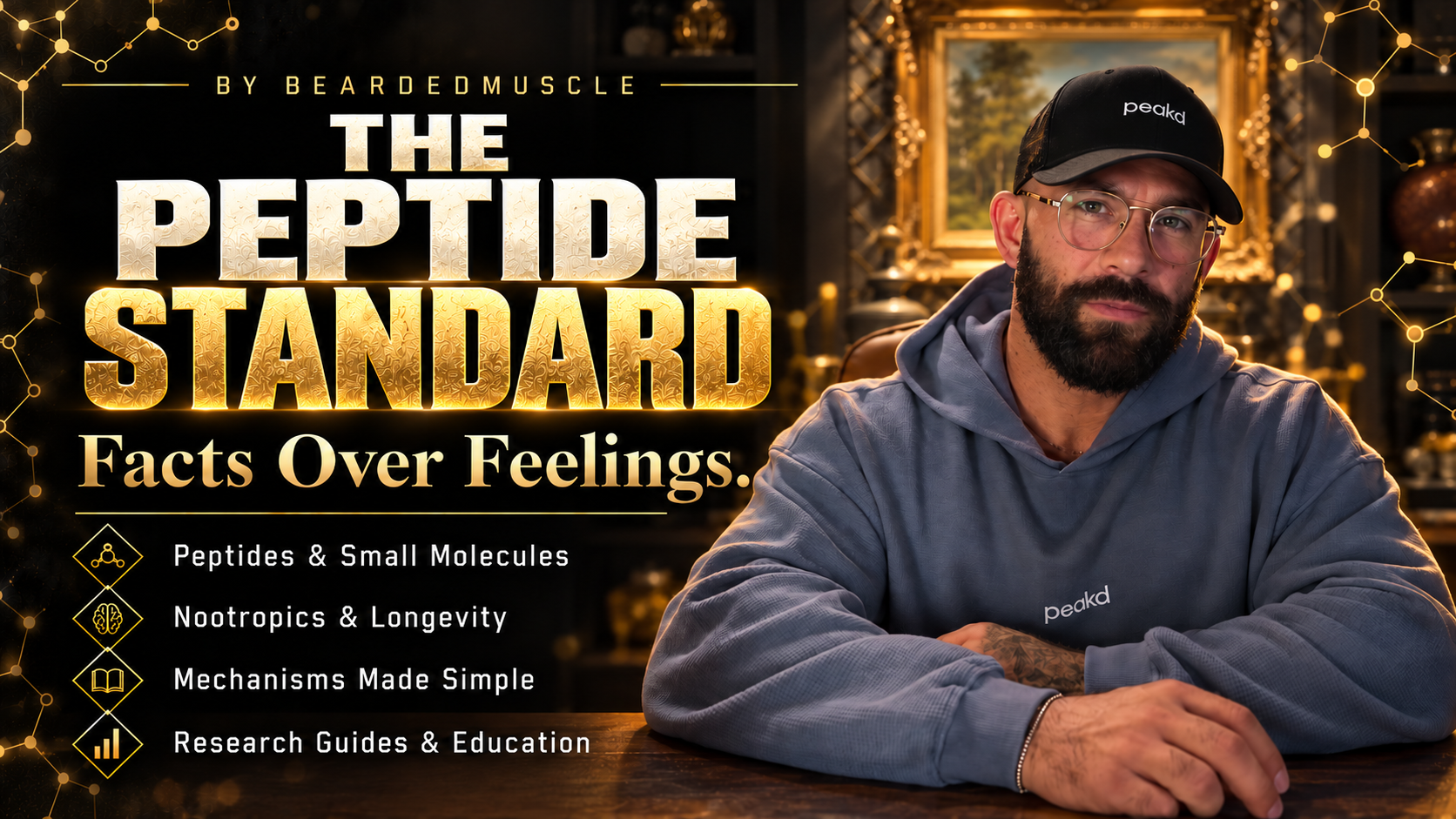
The Peptide Standard Skool community: Beardedmuscle portrait beside gold lettering, Facts Over Feelings, and peptide and research education topics.

On Skool

The Peptide Standard

Facts Over Feelings

For the curious reader of the literature: peptide science taken apart mechanism by mechanism, explained in plain language, including where the evidence runs out.

  • Peptide science and mechanisms
  • Study breakdowns and evidence gaps
  • Reading papers and lab documents
  • Questions and discussion on the topics above
Visit The Peptide Standard on Skool (opens in a new tab)

Learn by watching

Watch Education Videos

Explore peptide science, small molecules and research literacy with Beardedmuscle on TikTok and Instagram.

Education only. Not medical advice.

The Peptide Standard summarizes published research for learning and discussion. Nothing here recommends using any substance or promises any outcome; questions about your own health belong with a qualified clinician.

The Peptide Standard directory

Explore every section and breakdown.

Browse the site’s research primers, community information and complete public breakdown library.

Open searchable directory

Research & compound directory

All 20 published public breakdowns, organized by topic.

Search and filter the library